

- High Elasticity
- Low temperature properties
- Wear resistance
- Low hysteresis
- Good flexibility at ambient temperatures
- High abrasion resistance in severe conditions
- Low rolling resistance
- Durability and tensile strength and good elasticity

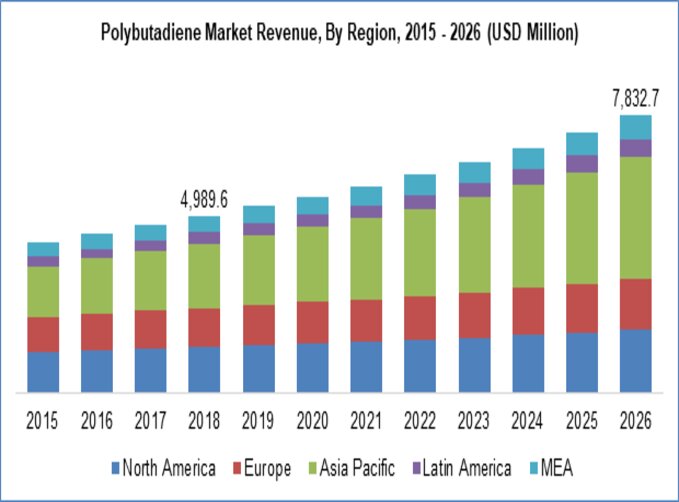
The global polybutadiene market size was valued at USD 4.98 billion in 2018 and is expected to grow at a CAGR of 5.9% from 2019 to 2026. Polybutadiene primarily referred to as Polybutadiene rubber is closely targeted in manufacture of synthetic tires. Polybutadeine is the second largest compound used in synthesis of synthetic rubber.
The end-user segment is characterized by growth of automotive segment accounting for highest share in global market in 2018. This growth accrues from increasing sophistication of vehicles and enhanced driving experience contributing to high growth. The leading players are catering to consumers whims and introducing new and innovative products in the market. Global players are venturing into market space with enhanced customer base and strong market presence. Thailand is a fast-growing market for polybutadiene during forecast period while China remained first in terms of both value and volume. In 2018, India, South Korea and Japan were greatest consumers of polybutadiene market.
North America alone accounted for considerable share of the market because of presence of major players in the continent including Goodyear, Cooper Tires and Pro-line. Demand in MEA will be hit because of price volatility in crude oil prices as result of reduced crude oil production.
Butadiene prices have to cope with large fluctuations due to fluctuations in volatile crude oil prices and global instability. Volatile crude oil prices and currency fluctuations will hamper growth. Furthermore, manufacturers are turning backs from petroleum-based products and adopting bio-based butadiene to counter adverse environmental effects of polybutadiene.
Manufacturers have switched sides from nickel-butadiene rubber facility to neo-dymium rubber facility due to high- running demand for cis derivatives used in manufacture of tires. The market is segmented across North America, Europe, Asia Pacific, Latin America and MEA. Asia Pacific dominated market share in the region due to manufacturing growth in car segment and production of cars beating market volatility. An upcoming economy, mushrooming of manufacturing industries, foreign investment and availability of low-cost labor in Asia are factors boosting growth of polybutadiene in Asia Pacific. Demand in Asia Pacific is high owing to presence of robust high-key players with companies such as JSR Corporation and Reliance Industries Ltd.

Polybutadiene rubber (BR) is used in the production of:
- Tires: Polybutadiene is largely used in various parts of automobile tires; the manufacture of tires consumes about 70% of the world production of polybutadiene, with a majority of it being high cis. The polybutadiene is used primarily in the sidewall of truck tires, this helps to improve fatigue to failure life due to the continuous flexing during run. As a result, tires will not blow out in extreme service conditions.
- Plastics: About 25% of the produced polybutadiene is used to improve the mechanical properties of plastics, in particular of high-impact polystyrene (HIPS) and to a lesser extent acrylonitrile butadiene styrene (ABS). The addition of between 4 and 12% polybutadiene to polystyrene transforms it from a fragile and delicate material to a ductile and resistant one.
- Golf balls: Most golf balls are made of an elastic core of polybutadiene surrounded by a layer of a harder material. Polybutadiene is preferred to other elastomers due to its high resilience.
- Polybutadiene rubber may be used in the inner tube of hoses for sandblasting, along with natural rubber. The main idea is to increase resilience. This rubber can also be used in the cover of hoses, mainly pneumatic and water hoses.
- This rubber can also be used in railway pads, bridge blocks, etc.
- Polybutadiene rubber can be blended with nitrile rubber for easy processing. However large use may affect oil resistance of nitrile rubber.

- 36 x 35Kg bales per crate (1260 KG).


)
Reviews
There are no reviews yet.